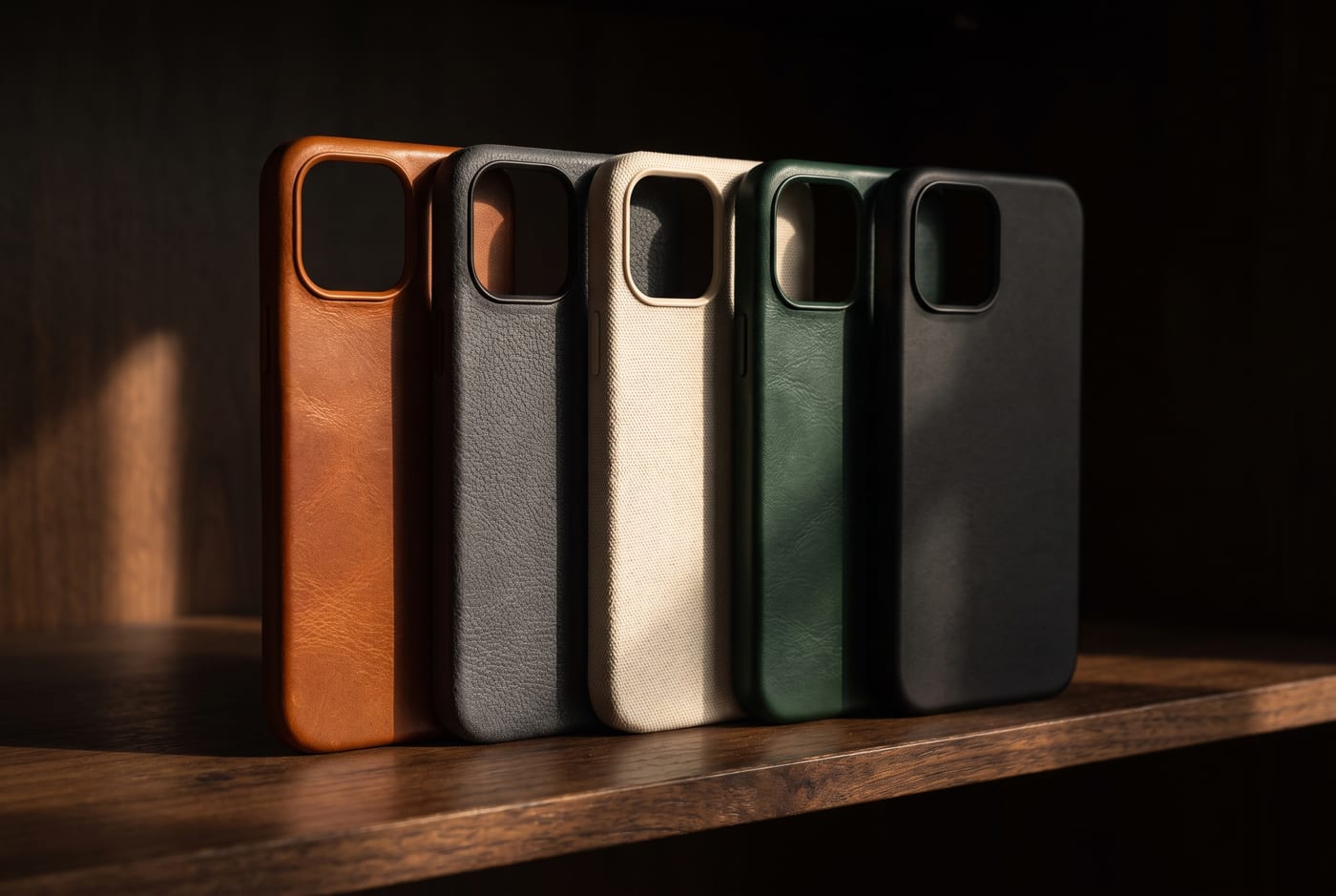
Stand on any train platform and count the phones. There will be dozens, and from the front they are functionally identical — a rectangle of glass, a status bar, someone's thumb moving in the universal gesture of scrolling. Then a phone turns over, and suddenly there is information. A scuffed clear shell with a concert ticket pressed under it. Saddle-brown leather gone dark at the corners. Matte black over black, so severe it reads as a policy. Rubberized armor with a lanyard, belonging to someone who has learned things the hard way. The front of a phone is what the manufacturer made. The back is what you did about it.
This is a strange situation when you think about it. Industrial design spent two decades refining the smartphone into one of the most considered objects ever mass-produced — tolerances measured in microns, colors argued over for months — and the first thing nearly all of us do is cover it. Around four in five phones wear a case. We take the most designed object we own and dress it.
The alibi of armor
Ask why, and the answer is always the same: protection. And it's true, as far as it goes. Phones are expensive, gravity is patient, and kitchen tile is unforgiving. A case is the cheapest insurance policy most of us will ever buy. But protection is an alibi, not an explanation. If armor were the whole story, every case would look like a tire — and instead the shelves hold lilac silicone, tortoiseshell, brushed titanium-look polymer, florals, translucent smoke. Nobody chooses lilac for its drop rating. The practical reason gets us into the store; something else entirely chooses the color.
That something is the same instinct that governs watch straps, glasses frames, and the jacket you reach for without thinking. The phone case belongs to a small class of objects that are technically functional and actually expressive — things we're allowed to choose for looks because there's a sensible cover story. The cover story matters. It lets a person who would never say the words 'this is my aesthetic' out loud make, in the accessories aisle, a precise aesthetic decision.
What the shell says
Every genre of case carries a legible message, whether or not the owner would sign it. The clear case says: I like the object itself, I just can't afford to be careless — a kind of pragmatic pride. Leather says patience; it's the only case that improves with damage, which tells you its owner thinks in years, not upgrade cycles. The battle-ready rugged case says my life is larger than my phone, and my phone had better keep up. The wallet folio says consolidation, a whole small philosophy of carrying less. And the caseless phone — increasingly rare, always noticed — says either supreme confidence or AppleCare, and sometimes both.
None of this is trivial, because the phone is not a neutral object to signal on. It's the most handled thing in your life. You'll touch it more times today than any doorknob, pen, or person. Objects that close to the body have always been dressed — that's what jewelry is, what a watch is, what a wedding ring is. The case sits exactly in that lineage: a decorated surface at the boundary between you and everyone looking at you. It's just the first piece of jewelry that also survives a fall onto concrete.
There's an interior audience too, and it may be the more important one. You see your own phone hundreds of times a day, and the shell is part of every glance. People who match their case to their wallpaper and icons — something members here do with a kind of quiet devotion whenever a new drop lands — aren't performing for the train platform. They're making the object they look at most feel deliberate. It's the same impulse as making the bed. Nobody inspects it. It still changes the room.
The dressed object
The best argument for taking any of this seriously is that you already do. You chose your case, even if you chose it quickly, and you'd wince at carrying certain others. That wince is taste — proof the decision was never really about drop protection. So it's worth making the choice on purpose: pick the shell that says what you'd actually sign your name to, let the leather scar, let the clear case carry its ticket stub. The phone came out of the box belonging to its designer. Dressed, it belongs to you.